Training teams to do product discovery
Through Catalyst’s Definition Program, we coached nine charities in defining, designing, and testing ideas for improving their digital services.
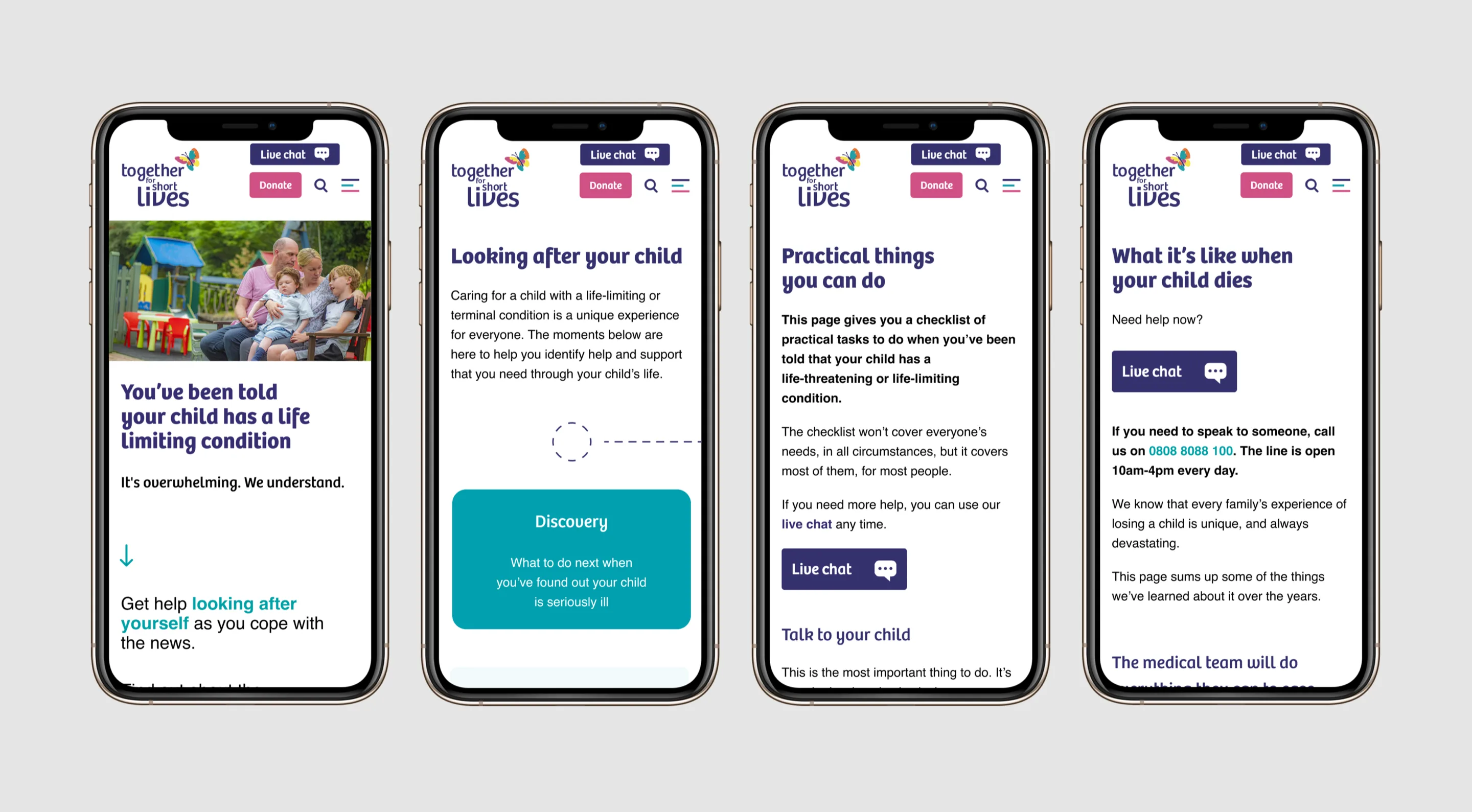
We helped the charity Together for Short Lives to design content to meet the needs of families who've just received the worst possible news.
- Client
- Catalyst
- Sector
- Charities
- Duration
- 10-week programme
- Our role
Catalyst is "An alliance of civil society organisations, funders, and digital agencies that support nonprofits to embed digital and design across their services, strategy and governance".
They asked us to be the 'digital partner' to a group of nine charities that were exploring ways to improve their digital content in order to better meet the needs of their users.
Our brief was to:
- Help the charities develop ideas for improving their services.
- Build understanding within the charities of how to develop better digital products and services through user-centred design.
- Discover service recipes that other charities with similar challenges could follow.
From needs to opportunities, to ideas and plans
We're used to working with one client at a time. So working with nine was a special kind of challenge!
Luckily the steps we needed to go through were the same as we'd take with any project.
Firstly we needed to make sure the charities understood the needs of their users. You can't design solutions if you don't understand what people need.
Secondly we needed to help them explore their ideas gathering feedback from users and stakeholders, and gradually narrowing them down to those that are most valuable, usable and feasible.
Lastly we needed to help them win support for their ideas and plan for delivery.
So we set up a 10 week programme to take them through these steps, with a combination of training, mentoring and a sprinkling of hands-on design work.
When we interviewed each charity it became clear that they each had their own goals, target users and level of digital maturity. So we segmented them into three groups, each with a different Panda mentor.
Alastair focused on charities with content design challenges. Whilst Ben helped the charities thinking about the structure and design of their sites, and Jon helped those with new product ideas.
Over the course of the 10 weeks we ran group learning sessions, did lots of one-to-one mentoring as well as some side-by-side collaborative working, crafting prototypes and testing them with users.
We also provided original training content for the charities to consume between sessions.
Giles Turnbull produced a series of videos on the basics of content design.
And Jon Gibbins did a series on designing for accessibility - ensuring everyone can benefit from the content being created.
Better services, new skills
Every charity got stuck into the activities and made fantastic progress over the course of the 10 weeks. It was really rewarding to work with people so focused on helping their users, for no other reason than that they need the help.
Panda's prototype re-framed expectations of what a prototype could be in our organisation.
Here are some examples of the work done in the programme:
- Global Link designed a service journey for refugees arriving in Lancaster.
- Together for Short Lives produced content to support parents in their moments of despair.
- Ashford Place created a way for people with dementia to find local support.
- Blood Cancer UK designed content to help people from ethnic minorities navigate the stigma associated with blood cancer in some communities.
Check the project website for a full run down of all the charities and their projects plus lots of useful links to content and training materials.
We really enjoyed working with Al and the team at Panda. Their user-centered design methodology really helped us focus and refine our thoughts, and the work we did on identifying specific user needs and prototyping and testing content with real users was immensely valuable.